
Checking Criminal History in Boulder
A Boulder search works best when it follows the record, not just the person's name. Boulder Police keeps its own reports and media. Boulder Municipal Court keeps ordinance, city traffic, parking, animal, photo-enforcement, and misdemeanor-code matters. Boulder County Jail records the booking when a city arrest leads to custody. State criminal charges then belong to District or County Court in the 20th Judicial District.
- Read the ticket, report number, or booking entry to identify the creating agency.
- Request the police narrative or incident media from Boulder Police Records.
- Check Boulder Municipal Court when the ticket is marked Municipal or concerns a city-code case.
- Use Boulder County booking and court channels for custody or state criminal charges.
- Use CBI only when a Colorado-wide reported criminal-history result is needed.
These five steps keep a local request from reaching the wrong custodian. They also separate an allegation in a police report from a charge in court and a final disposition.
Boulder Criminal Tickets by Color
Boulder Municipal Court publishes a rare visual shortcut. A municipal ticket has a yellow back and shows “Municipal” at the right. A state or county ticket uses blue text, shows “State,” and routes to County Court. This distinction can save a wasted call because the city clerk cannot produce a state court file merely because a Boulder officer issued the citation.
For a yellow municipal ticket, start with the city court. For a blue state ticket, call County Court at 303-441-3750 or use the 20th Judicial District route. The alleged act may have occurred on the same street, but the governing code and record custodian differ.
Note: The issuing officer's agency does not by itself reveal which court owns the resulting case.
Boulder Police Department Records
Boulder Police Records holds city police reports, photographs, body-camera and dash-camera video, 911 audio, and CAD incident material. Requests can reach the office through its counter, phone, email, fax, or official form. The form asks for requester and delivery details, the report number when known, involved person, incident type, date, time, location, selected records, an anti-solicitation affirmation, signature, and date.
The five contact routes point to one city custodian: 1805 33rd Street, 303-441-3300, pdrecords@bouldercolorado.gov, fax 303-441-4330, or the online request process. Police reports cost $5 for the first ten pages and $0.25 for each added page. Photographs, audio, and video cost $7 per medium. Extensive research, review, or redaction costs $30 per hour after the first hour. Media is not simply emailed under the form instructions.
The official city request page pictured below is the direct access point for a Boulder police record.
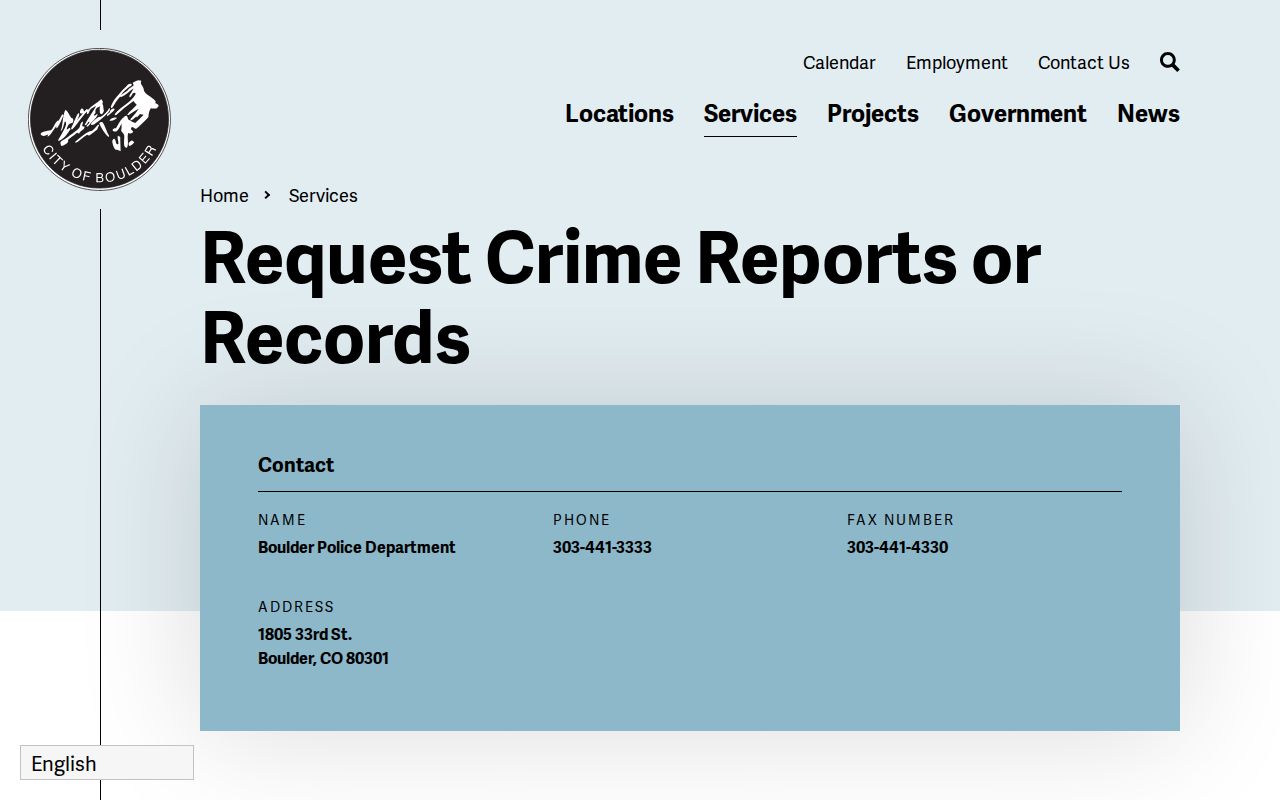
Its separate request process confirms that city reports do not pool into the Sheriff's Records Section.
Boulder Police Media Requests
Some Boulder criminal records use specialized contacts. Property and evidence requests go to propertyrequest@bouldercolorado.gov or 303-441-3340. Dispatch media uses PDCommAdmin@bouldercolorado.gov or 303-441-4309. Those routes matter when the desired item is evidence property, a 911 recording, or dispatch material rather than a standard narrative report.
Active investigations and protected content can be withheld or redacted under the Colorado Criminal Justice Records Act. Body-camera footage may also contain private material involving victims, minors, homes, or people who were never charged. A fee quote reflects the work needed to locate, review, and redact responsive material. It does not promise that every requested frame can be released.
A precise request reduces avoidable review. Give the incident date, approximate time, location, report number if known, and the kind of media sought. Name the involved person only when that detail helps identify the event. If the request spans many hours of video or a broad set of dispatch calls, BPD may need more labor to locate and screen the material. The released copy may omit protected segments while still supplying the public portion.
Boulder Arrests and Bookings
Boulder has no separate public city jail lookup. When BPD takes a person into custody and transports that person to the Boulder County Jail, jail staff create the booking record at 3200 Airport Road. The city police narrative remains with BPD. The Sheriff's daily listing then carries current custody and recent operational data.
The county's enhanced listing can search current inmate names and show daily bookings, releases since midnight, scheduled releases in the next 24 hours, and population views. Older bookings and adult arrest photographs require a Sheriff Records request. A blank current listing does not erase a past arrest, and the listing itself is informational rather than proof of guilt.
For full county access-channel detail, the Boulder County arrest lookup follows the jail, records-request, phone, court, and CBI routes. The city point is simpler: BPD owns its report, while BCSO owns the jail entry.
Boulder Police Records by the Numbers
BPD's 2024 report gives useful scale without measuring guilt. The department recorded 73,223 calls, 2,429 custodial arrests, 2,890 crashes, 6,968 records-information requests, and 20,791 reports. It also reported 1,752 person-crime incidents, 6,319 property-crime incidents, and 526 drug cases. A priority-one response ran slightly above six minutes.
These counts show workload and record volume. They should not be converted into a personal risk score or compared casually with another city whose categories and service demands differ.
Municipal Court Records in Boulder
Boulder Municipal Court operates at 1777 6th Street. It handles city ordinance matters, including municipal traffic, parking, photo enforcement, animals, and misdemeanor-code offenses. The court's records and forms hub includes routes for court records, discovery, transcripts, sealing, review, and jury demands.
| Court Name | Boulder Municipal Court |
|---|---|
| Case Types Heard | City ordinance, municipal traffic, parking, photo-enforcement, animal, and misdemeanor-code cases |
| Case Lookup Channel | Court records and forms hub, clerk counter, email, or phone |
| What the Docket Shows | Filings, scheduled events, case activity, and time from filing to closure |
| Copies & Fees | Request through the municipal clerk; confirm the current charge for the requested product |
The court is open Monday through Friday from 8 a.m. to 4:30 p.m., except that it closes from 8 a.m. to 1 p.m. on the third Friday of each month. Main telephone is 303-441-1841, ticket questions go to 303-441-4212, and email is bouldermunicipalcourt@bouldercolorado.gov.
The municipal court interface pictured below leads to the city-level docket and contact information.
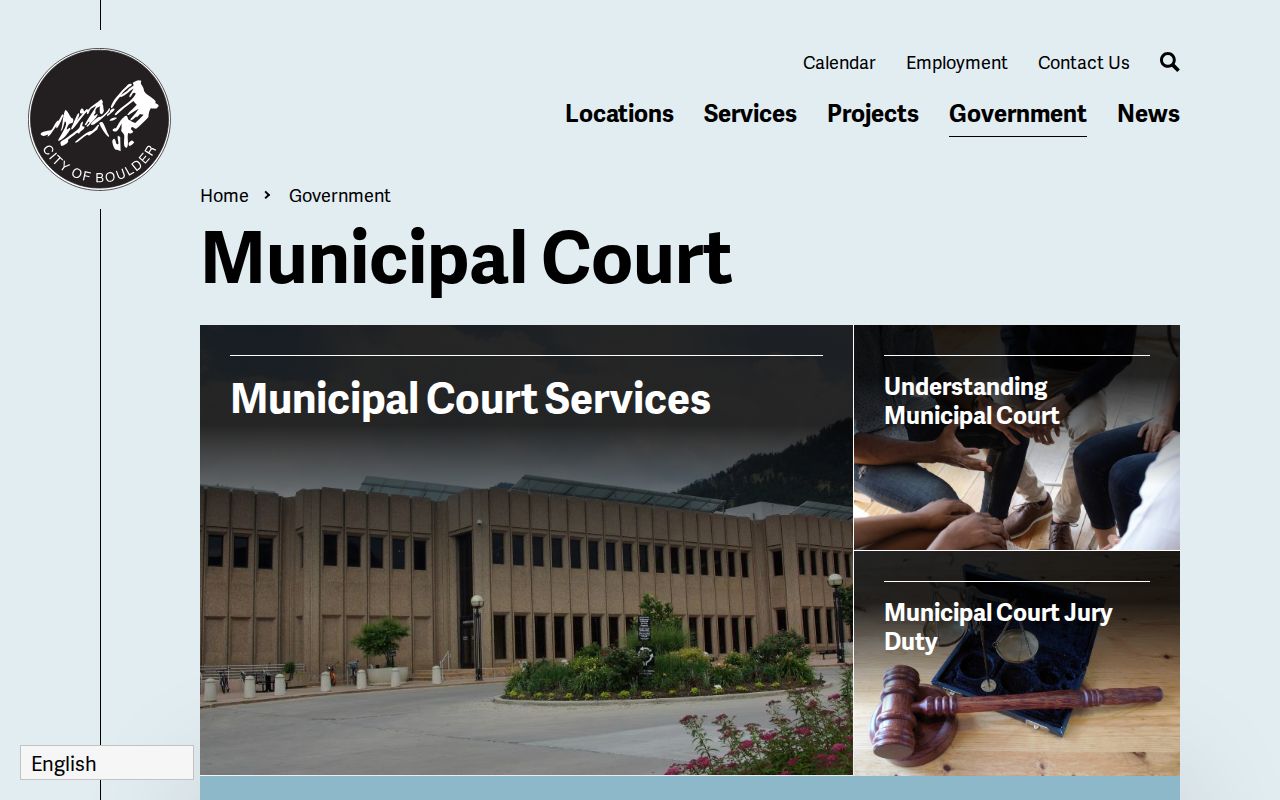
That municipal channel is separate from the 20th Judicial District file for Colorado charges.
Boulder Municipal Warrant Line
The Violations Bureau and warrant line is 303-441-1840. It is the direct city contact for a Boulder Municipal Court warrant question. A state case warrant belongs with the county court route, not the municipal clerk.
The city has participated in coordinated warrant-resolution events, but a past event is not a promise that an unscheduled visit will be arrest-free. Call the court, verify the current process, and get legal advice when needed. Do not rely on a past program announcement as current warrant status.
Boulder Resolution Program Limits
Municipal Court's resolution program does not cover every city charge. The court states that serious allegations such as obstruction, resisting arrest, harassment, assault, and disorderly conduct generally are not eligible. A person should read the filed charge and current court instructions instead of assuming that every code case follows the same informal path.
This is also why the docket matters. A police narrative may describe several alleged acts, but only the court record shows which municipal charges were filed and how they ended. Discovery, transcripts, review, and sealing each use separate forms because they serve different procedural needs.
The city's data dashboard tracks filings and the time from filing to closure. Those measures describe court operations, not the merits of one case. A closed matter still requires its docket and disposition to show whether it ended by payment, dismissal, plea, hearing, or another route. When a record is eligible for sealing, use the municipal sealing process tied to that case instead of sending a general police-record request.
Where Boulder Criminal Records Go
A serious BPD case can create three records at once. Police keep the incident narrative and media. The county jail creates the booking when custody occurs. The District Attorney and 20th Judicial District create a state court file if charges are filed. Municipal code cases stay with Boulder Municipal Court instead.
Record flow: Boulder Police Department › Boulder County Courts › Colorado Bureau of Investigation
The flow is not instant or perfectly interchangeable. A recent city arrest may appear in the jail listing before a case is filed. A summons may produce a court file without a fingerprint-supported jail cycle. Later, the court disposition should feed state channels, but CBI warns that its record is limited to information received and properly matched.
For the filed charge, plea, motion, disposition, or sentence, use the Boulder County criminal court case route rather than asking BPD to interpret the court outcome.
Boulder Police or CU Police
The University of Colorado campus adds a key local boundary. CU Police is a separate law-enforcement agency, so its reports are not automatically BPD records. The location of an event within the city limits does not guarantee that Boulder Police created the report.
The official University of Colorado Police page shown below helps identify the campus custodian.
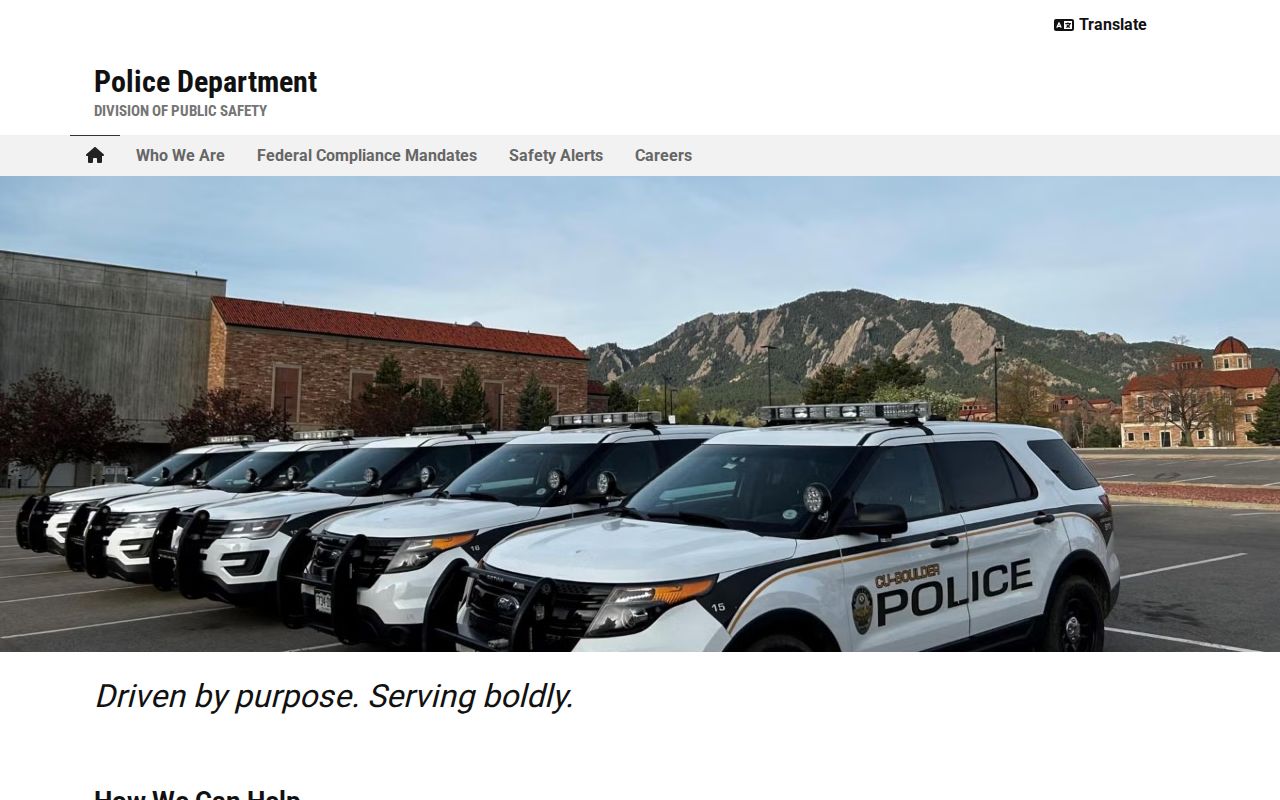
Check the report header, citation, or arresting-agency field before choosing between CU Police, BPD, and the Boulder County Sheriff.
A joint response can produce records at more than one office. Ask which agency assigned the case number and which officer authored the report. If an arrest followed, the county jail entry may name the arresting agency and help route the narrative request. That field is a clue to custody origin, not a substitute for the full report.
Public Access Rules in Boulder
Boulder Police and Municipal Court do not apply one identical disclosure rule. Police reports are criminal-justice records governed mainly by CCJRA. Court records also follow Judicial Branch access policy. CORA governs many other city records, but it is not a substitute for the agency-specific police request route.
Key Statutes:
Colorado Open Records Act, C.R.S. §§24-72-200.1 through 205 governs many public records subject to exceptions and custodian procedures.
Colorado Criminal Justice Records Act, C.R.S. §§24-72-301 through 309 more specifically controls police and other criminal-justice records.
C.R.S. §24-72-305.5 restricts obtaining criminal-justice records for direct commercial solicitation.
Victim data, juvenile material, personal identifiers, sealed matters, and information that could harm an active investigation may be withheld or redacted. Public access never turns a charge into proof of guilt. Send each request to the office that made or keeps the record, and describe the item with enough detail for staff to locate it.