
Checking Criminal History in Lafayette
Begin with the custodian that created the record. Lafayette Police handles incident and arrest reports. Municipal Court holds city-code and traffic case files. The Boulder County jail listing covers custodial booking, while the 20th Judicial District holds state-law prosecutions. CBI is the statewide source for a name-based Colorado history.
- Gather the report number, incident date, involved name, and record type when those details are known.
- Submit Lafayette’s Criminal Justice Record Request for police material or a local verification letter.
- Ask Municipal Court for a city docket, copy, discovery, or certification.
- Check Boulder County’s Daily Listing if Lafayette Police made a custodial arrest.
- Move to the county court or CBI channel only when the scope extends beyond a city record.
The countywide Boulder County criminal history resource gives more detail on the final two channels. Keeping Lafayette requests at city altitude prevents duplicate requests and wrong-office delays.
Lafayette Criminal Record Request Fields
Lafayette’s online Criminal Justice Record Request is unusually clear about what it collects. No city account is required. An account only saves and autofills information. The form asks for enough requester and event detail to match the right police file and includes a statutory anti-solicitation acknowledgment.
| Field | What to enter | Status |
|---|---|---|
| Date and requester | Date of request and requester name | Required |
| Contact | Address, city, state, ZIP, telephone, and email | Telephone and email required |
| Case identifiers | Report number, incident date, and involved person | Optional but useful |
| Record type | Report, certified copy, verification letter, photos, video, drive, or other | Select what is sought |
| Certification | Anti-solicitation acknowledgment, signature, confirmation, and reCAPTCHA | Required |
The official Lafayette form displays those choices in the city request system.
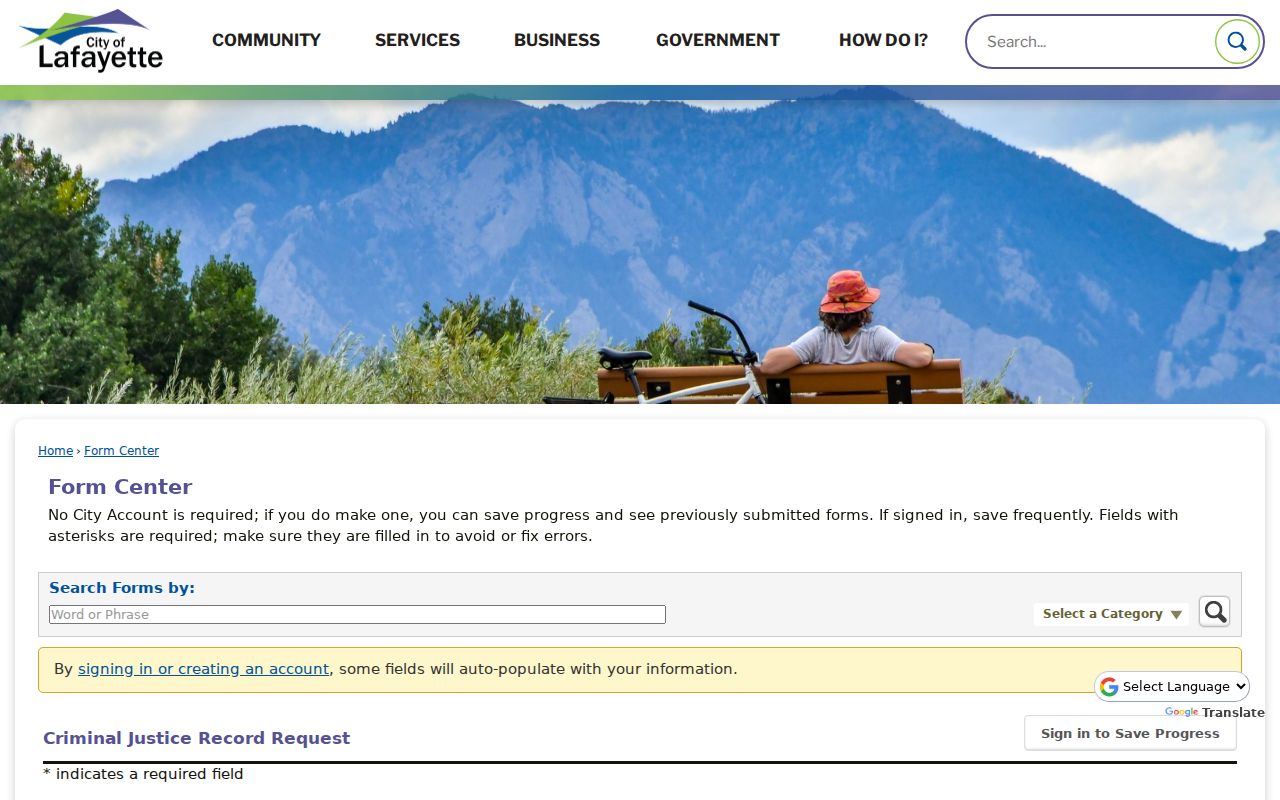
The form image helps a requester pick the right product before staff calculates the price.
An optional checkbox sends the requester an email copy. The submission itself may become a public record, and staff may require identification before releasing protected material.
Lafayette Police Department Records
Lafayette Police Department routes criminal-justice files through Police Records at 303-665-5571. Available products include an ordinary police report, a certified copy, a records check or verification letter, photos, body-worn or other video, a thumb drive, and another specified record. Selecting the right box matters because each product has a distinct fee and review path.
The department can include photos by email. Video normally arrives through a hyperlink unless the file is too large or the requester asks for a drive. Research and redaction may be substantial for video, and the city instructs requesters not to pay until a representative confirms the price.
The official police page shows the city office tied to these Lafayette criminal records.

The city’s direct police route is the correct starting point for the incident narrative, even when later custody and court records sit elsewhere.
Lafayette Report and Video Fees
Police fees depend on both the medium and the work needed to prepare it. A paper report starts at $7 for the first ten pages, then costs $0.25 for each extra page. Certification adds $5. A records check or verification letter costs $20, as does a thumb drive.
| Police product | Published amount |
|---|---|
| First ten report pages | $7 |
| Each additional page | $0.25 |
| Certification | $5 additional |
| Records check or verification letter | $20 |
| Thumb drive | $20 |
| Video research or redaction | $40 per hour |
Research has a one-hour minimum. Redaction begins with a four-hour prepaid estimate that is reconciled to the actual work. Waiting for staff’s quote avoids sending the wrong amount before the scope and delivery method are known.
Payment caution: Do not pay a Lafayette Police records fee until a representative confirms the amount.
Lafayette Arrests and Bookings
A custodial arrest by Lafayette Police produces records in more than one system. The incident report remains with the city department. Boulder County Jail creates the booking entry, which can appear in the county Daily Listing. If prosecutors file a state-law case, the court record belongs to the 20th Judicial District.
The jail listing does not replace the police narrative. It shows custody facts rather than the full investigation. Likewise, the initial arrest charges may differ from charges later filed in court. Use the site’s Boulder County arrest lookup for the county roster and booking channels, while keeping the report request with Lafayette Police.
Note: An arrest records an allegation and custody event, not a finding of guilt.
Lafayette Arrest Records by Numbers
Lafayette reported 24,710 calls and 846 arrests in 2024. The same annual figures list 15 use-of-force incidents, no in-custody deaths, and 1,723 animal calls. These counts give scale to the records operation without saying what happened in any one case.
Call volume is not a count of crimes, and arrest volume is not a count of convictions. A requester needs the police report or relevant court disposition to understand a specific Lafayette event.
Municipal Court Records in Lafayette
Lafayette Municipal Court is a court of record with limited jurisdiction over city code, traffic and parking, animal and code matters, and criminal petty or misdemeanor offenses. It is at 451 North 111th Street, Lafayette, CO 80026. The telephone is 303-604-8000, and email is municipalcourts@lafayetteco.gov. The clerk’s weekday hours are 8 a.m. to 5 p.m.
| Court Name | Lafayette Municipal Court, a limited-jurisdiction court of record |
|---|---|
| Case Types Heard | City code, traffic, parking, animal, criminal petty, and misdemeanor matters |
| Case Lookup Channel | PDF court-record request submitted to the Municipal Court clerk |
| What the Request Identifies | Defendant, date of birth, case or citation, requested material, contact, signature, and fee acknowledgment |
| Copies & Fees | Page, photo, USB, certification, and research charges depend on the product |
The court sits three times each month. Appearances are in person unless virtual participation is specifically approved. Judge Amanda Bailhache presides, with Court Administrator Genevieve Rotella and clerk Emily Collier named by the city.
The city’s court page is also the source for the request and session information.
The court image marks a separate record custodian from Police Records, despite both offices serving the same city.
Lafayette Court Copy Fees
The municipal court’s PDF request is tailored to court files, not police reports. It identifies the defendant, date of birth, case or citation number, requested material, contact information, signature, and fee acknowledgment. Copies cost $0.25 per page. Color photos are $0.75, a USB is $5, and certification is $5.
Research and retrieval cost $33.58 per hour after the first hour. The public fee list also shows a $65 sealing fee and a $75 warrant fee among other case charges. These are court fees and should not be mixed with Police Records pricing.
| Municipal Court item | Fee |
|---|---|
| Copy page | $0.25 |
| Color photo | $0.75 |
| USB | $5 |
| Certification | $5 |
| Research or retrieval | $33.58 per hour after first hour |
| Sealing or warrant fee | $65 or $75 |
Lafayette Discovery Delivery Choices
Discovery is material exchanged for a pending case, and it follows a distinct Municipal Court form. The requester describes the desired material or selects “Other,” then chooses mail, pickup, or email delivery. The form asks for the defendant and case, signature and date, plus contact details. A parent signs for a juvenile.
Electronic discovery is free. That does not make every court file free, and it does not turn discovery into a public police-report request. A party seeking case material should use the discovery form. A member of the public seeking a docket copy should use the court-record route.
Lafayette Court Session Timing
Lafayette Municipal Court sits only three times each month, so the public counter’s weekday hours do not mean a judge hears cases each day. A person with a citation should rely on the date in the case record and confirm it with the clerk. In-person appearance is the default. Virtual participation requires specific approval rather than a simple preference selected on the records form.
This schedule can also affect how a Lafayette disposition appears across systems. Police may close their report while the city case is still waiting for a court session. The municipal docket is the better source for the current court stage, and the signed judgment or register is the stronger source for the final result. A police verification letter cannot replace that court outcome.
Lafayette Local Code Records
Lafayette’s municipal docket reaches deeply into local rules. It includes animal and code matters, even prairie-dog-control provisions. That local scope is why a municipal record should not be mistaken for a statewide County Court prosecution. Both can involve conduct labeled an offense, yet they arise under different law and remain with different clerks.
Use the citation caption and issuing agency as routing clues. A city-code reference belongs with Lafayette Municipal Court. A Colorado statute or county case number points toward the 20th Judicial District. When uncertain, the municipal clerk can confirm whether a docket exists before a paid copy request is submitted.
Where Lafayette Records Go
Lafayette Police owns the incident report. A custodial arrest creates a Boulder County Jail entry. City-code charges go to Municipal Court, while state-law charges go to the 20th Judicial District. Eligible arrest and disposition data may then be reported to the Colorado Bureau of Investigation.
Record flow: Lafayette Police › Boulder County Jail or Courts › Colorado Bureau of Investigation
Each layer answers a different question. Use city police for what officers documented, the jail for custody, the correct court for charges and outcome, and CBI for reported statewide history.
Public Access Rules in Lafayette
Police criminal-justice material is governed by the Colorado Criminal Justice Records Act rather than the ordinary city-record process alone. Lafayette may require identification, redact protected details, or withhold material when disclosure would harm an investigation or violate privacy and confidentiality rules. Municipal court access also narrows for sealed, juvenile, and otherwise protected files.
The Lafayette public-records route helps distinguish general city records from the direct police request. The official demographic source also confirms Lafayette’s place among Boulder County’s largest incorporated cities.
The statewide municipal context does not change the local rule: send police files to Police Records and city dockets to Municipal Court.
Key Statutes:
Colorado Open Records Act, C.R.S. §§ 24-72-200.1 through 24-72-205 governs many general city records.
Colorado Criminal Justice Records Act, C.R.S. §§ 24-72-301 through 24-72-309 governs access to police and criminal-justice files.
C.R.S. § 24-72-305.5 limits direct commercial solicitation based on criminal-justice records.
Note: Wait for a Lafayette Police representative to confirm the final price before paying for a report, video, or verification letter.